 +86 (028) 8535 5966
 +86 17323184180
 irvotex@votinfrared.com
 Links
Links

What Can (and Can't) Thermal Optics See?
2026/03/10If you’ve watched a spy movie or played a tactical video game, you probably have a specific image of thermal optics in your head. You might picture a high-tech gadget that lets you look through concrete walls, spot enemies hiding deep underwater, or perhaps even read a newspaper from a mile away in total darkness.
While thermal imaging technology is undeniably impressive, it isn’t quite the X-ray vision that Hollywood often portrays. In this blog, we will clarify common misconceptions, explain the science, and dive into exactly what your thermal optics can reveal and where it hits a wall (literally).
How Do Thermal Optics Actually Work?
Thermal optics do not “see” objects themselves. In fact, they see differences in temperature. Every object with a temperature above absolute zero emits infrared radiation. A thermal sensor measures this radiation and translates it into an image based on relative heat values, not color, texture, or shape.
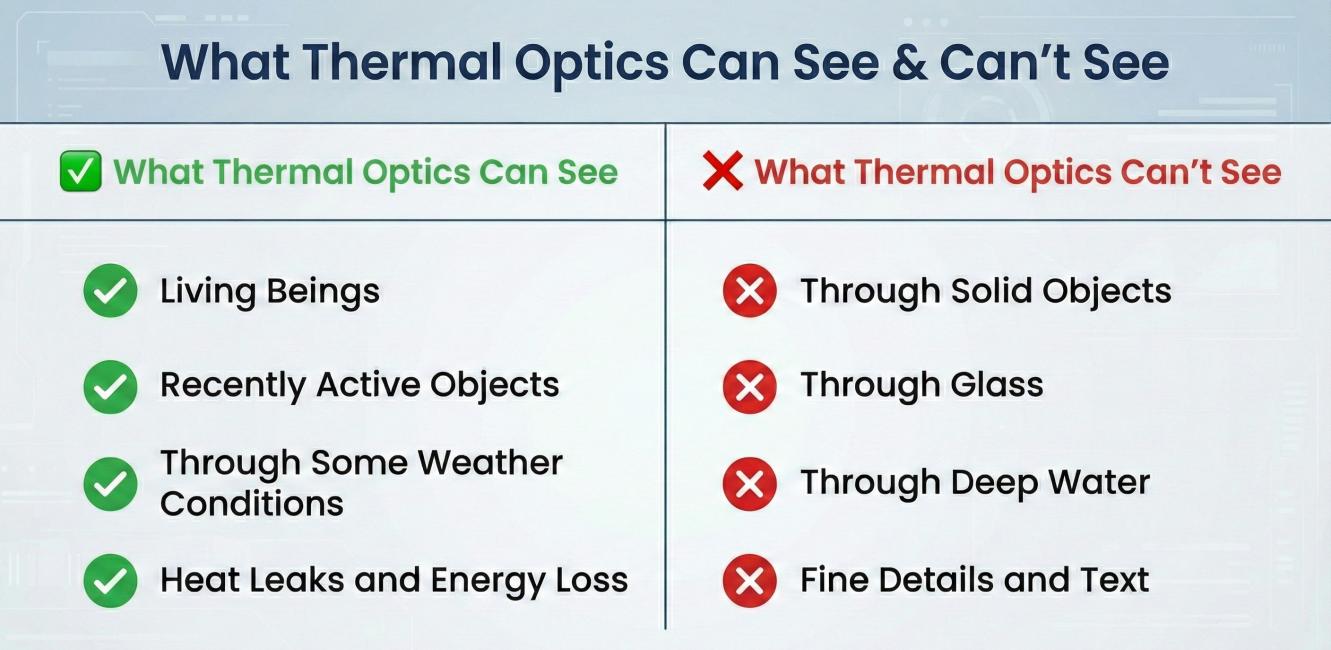
What Thermal Optics Can See
Now that we know the science, let’s look at what thermal imaging actually reveals:
1. Living Beings
Humans and warm-blooded animals maintain a body temperature significantly higher than the environment. The result is a highly visible heat signature that stands out against cooler backgrounds like trees or grass.
A common myth is that ectotherms like snakes or alligators are invisible to thermal imaging. This isn’t entirely true. While they are harder to detect than warm-blooded mammals, they are visible if their body temperature differs from their surroundings—for instance, if they have been basking in the sun or are moving across cool ground.
2. Recently Active Objects
Thermal vision is excellent at spotting the “ghosts” of recent activity. If a car has been driven recently, its engine and tires will glow in the thermal spectrum even after the ignition is cut. Similarly, footsteps can sometimes be detected. If a person walks across a cool floor, their body heat transfers to the ground, leaving a temporary thermal footprint that a sensitive camera can pick up for several moments.
3. Through Some Weather Conditions
One of the biggest advantages of thermal tech is its ability to cut through atmospheric obscurants.
· Total Darkness: Since it doesn’t need light, thermal works well in pitch black.
· Smoke: Light smoke particles are small enough that long-wave infrared radiation passes right through them.
· Fog and Vegetation: Thermal optics can often see through light fog, brush, and tall grass.
4. Heat Leaks and Energy Loss
For homeowners and professionals, thermal cameras are diagnostic tools. They can “see” missing insulation in walls because those spots will appear colder (or hotter) than the surrounding drywall. They can also detect hot water pipes running behind a wall or identify an overheating breaker in an electrical panel before it catches fire.
What Thermal Optics Can’t See
Despite its power, thermal technology has physical limitations.
1. Through Solid Objects
This is the biggest misconception. Thermal cameras cannot see through solid walls like X-ray machines. If you point a thermal device at a concrete wall, you are seeing the temperature of the wall’s surface, not what is behind it.
Exception: If a very hot object (like a fire or a burst steam pipe) is directly behind a thin wall, it might heat up the wall itself. The camera will see the “hot spot” on the wall, but it isn't seeing through the wall; it is seeing the heat transfer.
2. Through Glass
This limitation often catches first-time users off guard. If you are sitting in your truck and try to scan a field through the windshield with your thermal monocular, you won’t see the deer outside. This is because glass acts like a mirror to infrared radiation. It reflects the thermal energy back rather than letting it pass through.
3. Through Deep Water
Water also blocks infrared radiation. While you can easily spot a person floating on the surface of a lake (because their head is warmer than the water), you cannot see anything submerged. Once an object goes underwater, its heat signature is masked by the water itself.
4. Fine Details and Text
Thermal imaging relies on heat differences, not color or contrast. This means it cannot “read” a book, a license plate, or a street sign, because the ink and the paper (or the paint and the metal) are usually the same temperature.
Conclusion
Thermal devices reveal what the naked eye cannot, but they also have limits. It is essential to understand the science behind thermal imaging so you can use your device effectively. Equally important is having high-performance equipment. Check out IRVOTEX, a trusted provider of thermal optics.


